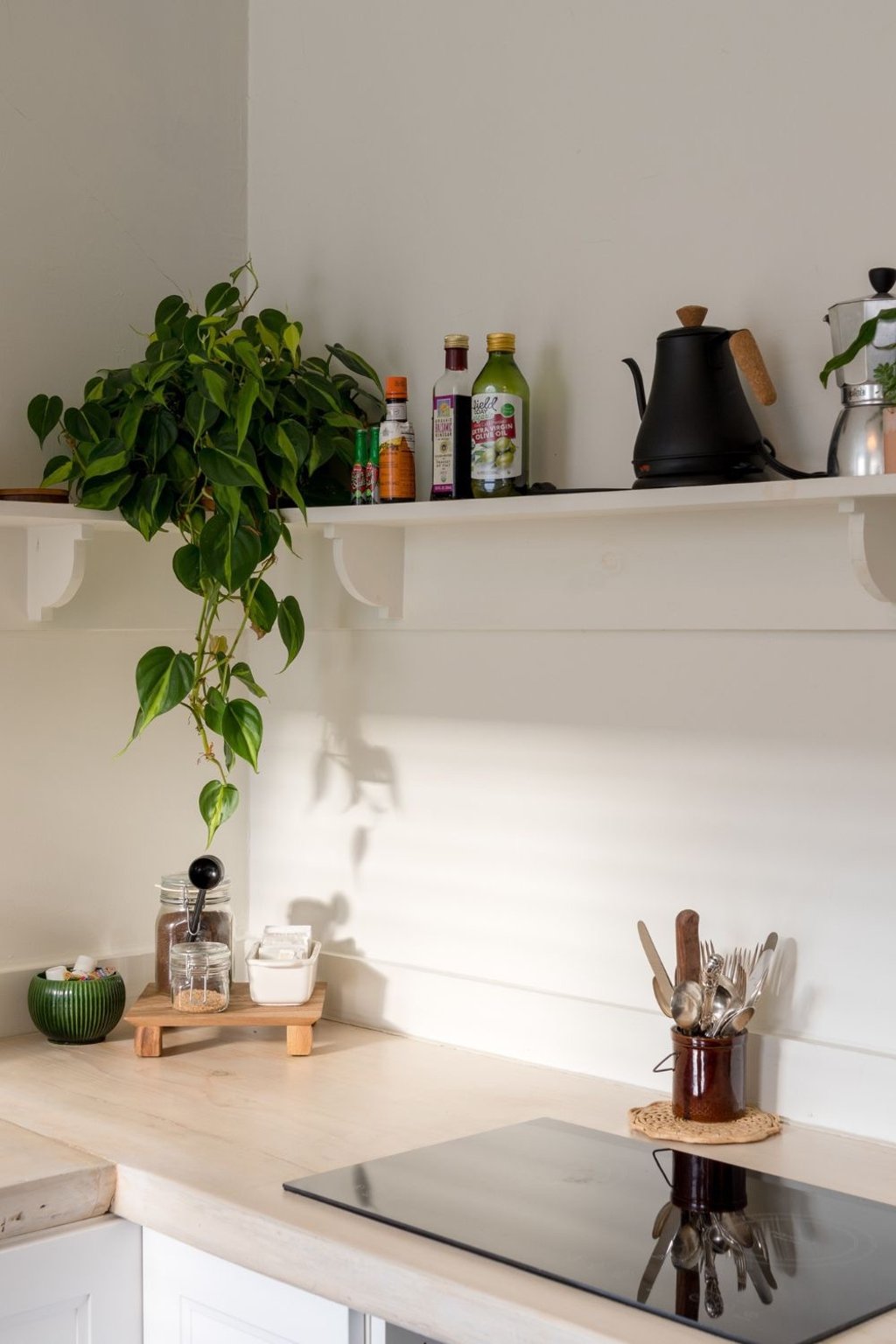
The Countertop Clutter Rule
Kitchen counters have a funny way of collecting absolutely everything.
Mail.
Water bottles.
Receipts.
Snacks.
Random cords.
A blender you used three days ago.
A mysterious pile nobody claims ownership of.
And somehow, no matter how many times you clean them off, the clutter slowly creeps back like it pays rent there.
Here’s the truth most people don’t realize:
Counter clutter usually isn’t a cleaning problem.
It’s a boundary problem.
That’s where the Countertop Clutter Rule comes in.
What Is the Countertop Clutter Rule?
The rule is simple:
Only items used daily earn permanent counter space.
That’s it.
If something is not used almost every single day, it probably does not belong sitting out full time.
This rule instantly changes the way your kitchen looks because it forces your counters to stop functioning as long-term storage.
Counters are workspace.
Not overflow parking lots.
Why Countertops Get Out of Control So Fast
The kitchen is the busiest room in most homes.
Everything passes through it.
Which means countertops naturally become:
Drop zones
Temporary holding areas
Storage overflow
Decision avoidance stations
The problem is that “temporary” clutter tends to become permanent surprisingly fast.
One appliance becomes three.
One paper pile becomes six.
One unopened package suddenly lives there indefinitely.
Without boundaries, countertops expand to hold whatever the home cannot manage elsewhere.
The Visual Weight of Clutter
Even when counters aren’t technically dirty, too much visual clutter makes the entire kitchen feel chaotic.
Your brain is constantly processing:
Shapes
Colors
Stacks
Cords
Containers
Open packaging
Miscellaneous objects
The more visual information on a counter, the more stressful the room tends to feel.
Clearing counters creates visual calm almost immediately — even before deep cleaning starts.
It’s one of the fastest “home reset” tricks that actually works.
The Everyday Item Test
If you’re unsure what deserves counter space, ask yourself:
Do I use this every day?
If yes, it may deserve a spot.
Does this make daily life easier?
Coffee maker? Probably yes.
Toaster oven used every morning? Maybe yes.
Am I keeping this out because I’m avoiding putting it away?
That’s usually a clue.
Would my kitchen feel calmer without this visible?
If the answer is yes… trust that instinct.
The Hidden Problem: Overcrowded Cabinets
Sometimes countertop clutter is not really about the counters at all.
It’s about cabinets being too full.
When storage spaces are overloaded:
Appliances stay out
Pantry items spill onto counters
Dishes migrate everywhere
Nothing has a true home
Organization works much better when there’s breathing room.
Decluttering cabinets often clears countertops automatically.
The One-Minute Counter Reset
One of the best habits for maintaining clear counters is doing a quick nightly reset.
Not a deep clean.
Not a major project.
Just one intentional minute.
Try this:
Toss trash
Put away stray items
Clear dishes
Wipe surfaces
Reset one hotspot
That tiny reset prevents tomorrow’s clutter from stacking on top of today’s clutter.
Because clutter compounds quickly.
But so do small habits.
The Goal Is Functional, Not Empty
Let’s be clear:
A real kitchen should still look lived in.
You do not need sterile magazine counters with one decorative lemon bowl and emotional support eucalyptus.
The goal is function.
You want enough open counter space to:
Prep food easily
Clean quickly
Reduce stress visually
Make the kitchen easier to maintain
A calm kitchen is usually not about perfection.
It’s about reducing friction.
Start Small
You do not need to reorganize the entire kitchen today.
Start with one section of countertop.
Clear it completely.
Only return the items that truly earn the space.
You’ll probably notice something immediately:
The kitchen feels lighter.
Cleaner.
Calmer.
Not because you became a different person overnight.
Because your counters finally had boundaries.
If countertop clutter constantly returns no matter how often you clean, The Organizing Surfaces Guide helps you create realistic systems for kitchen counters, bathroom counters, entry tables, nightstands, and every flat surface that tends to collect chaos.